
Created a UX Testing framework for a global nonprofit to improve the user experience of their Canvas LMS.
Generation, You Employed
Role: UX Consultant
Timeline: 6 months
Project Type: Pro-bono UX consulting engagement
Key Activities & Deliverables:
Research strategy & scoping
Stakeholder alignment
Tool benchmarking & evaluation
Usability test pilot
Usability test facilitation guide creation
Context
Generation, You Employed is a global nonprofit that serves ~20,000 online learners annually across 17 countries, up from just 50 learners in 2019. As they rapidly scaled, their Global Online Learning Team needed a structured way to conduct usability tests with learners, alumni, instructors, and local team members to evaluate their task flows, understand challenges with their learning management system (LMS), and gain general insight into the user experience from different perspectives to inform their strategy/priorities.
The Problem
They had quantitative survey data and made adjustments based on their own hypotheses, but they had no structured way of testing their assumptions. They lacked a repeatable UX testing framework to evaluate user experiences. They needed a tool that allows them to experience the world of online learning from the perspective of each user group (learner, instructor, alumni, local team) so they can assess how our improvements have landed and continue to refine their practices/tools/platforms for online learning.
The Solution
As a UX Consultant for Autodesk’s Employee Impact Program, I, along with another UX Consultant, helped develop a scalable, resource-conscious UX testing framework that could be reused across countries, roles, and future product updates
Our Approach & Process

Phase 1: Strategic Scoping & Alignment
We aligned on:
Research goals and priorities.
Key user behaviors to evaluate (progress tracking, homepage navigation).
Deliverables and success metrics.
Boundaries and constraints to be mindful of.
What is out of scope for the project.
Other collaboration and logistical items.
Phase 2: Tool Evaluation & Framework Design
Before designing the study, we benchmarked usability testing tool platforms across cost, supported languages, data outputs, and moderated vs. unmoderated capabilities to ensure the framework would scale sustainably across countries.
Usability Testing Tool Evaluation
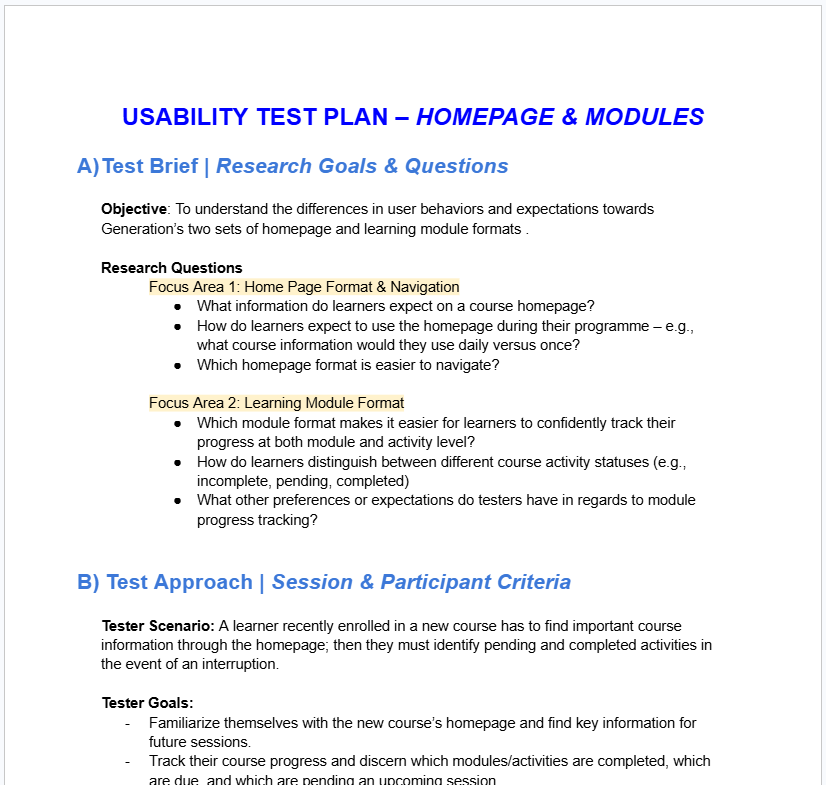
After finalizing the method for conducting usability tests that worked best for Generation, we developed a full usability test plan, a facilitation guide, and created participant recruitment and communication templates.
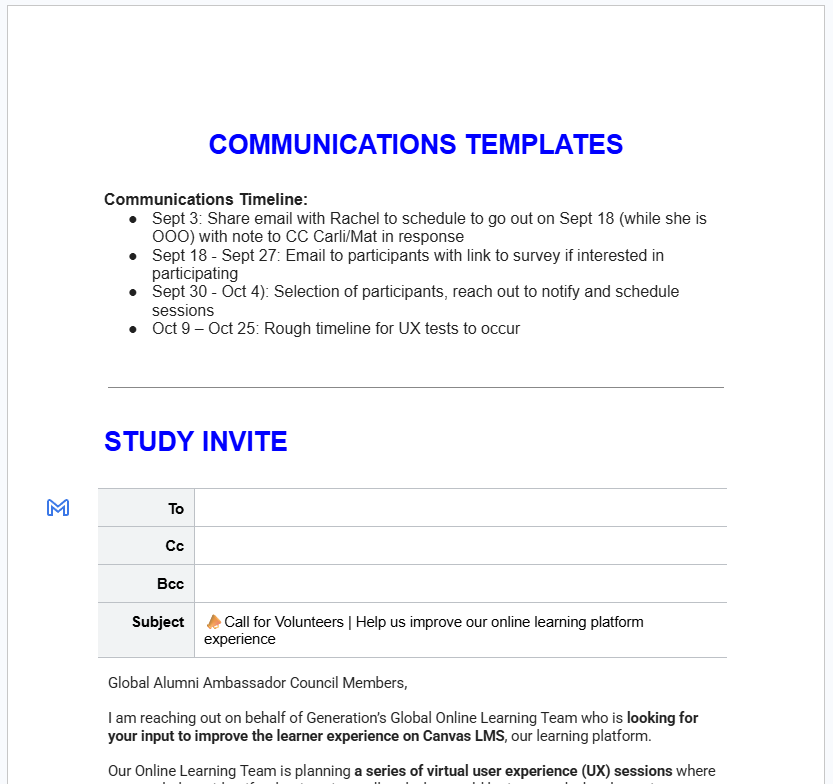
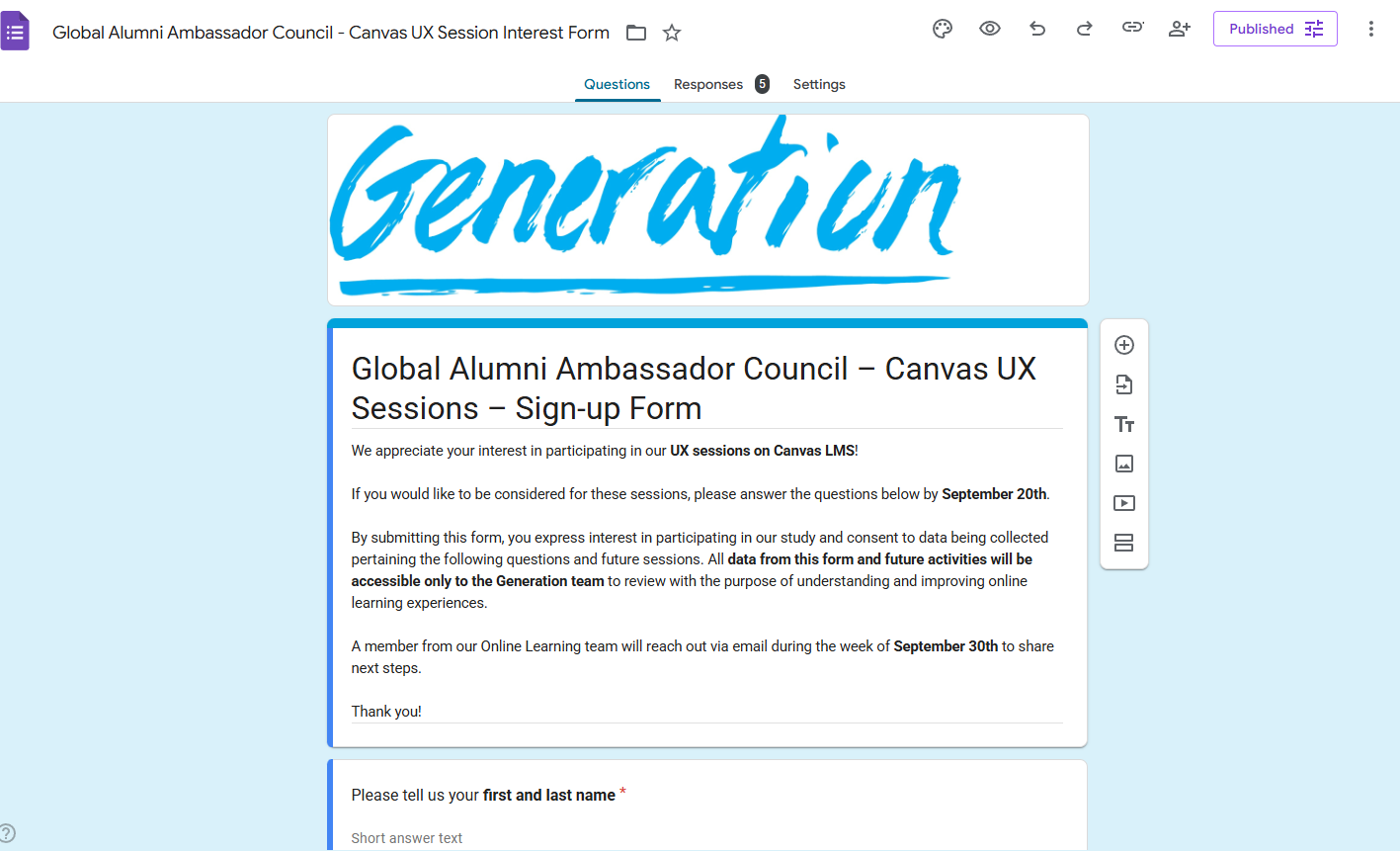
Communications and Recruitment Templates; Usability Test Plan
After completing the usability testing guide, we conducted a pilot test to ensure clarity and gather feedback for any additional edits before conducting live tests with participants. Upon conclusion of our engagement, we provided Generation with an end-to-end Usability Test Facilitation Guide and additional resources for future tests as they scale their online learning offering.
Phase 3: Testing and Handoff
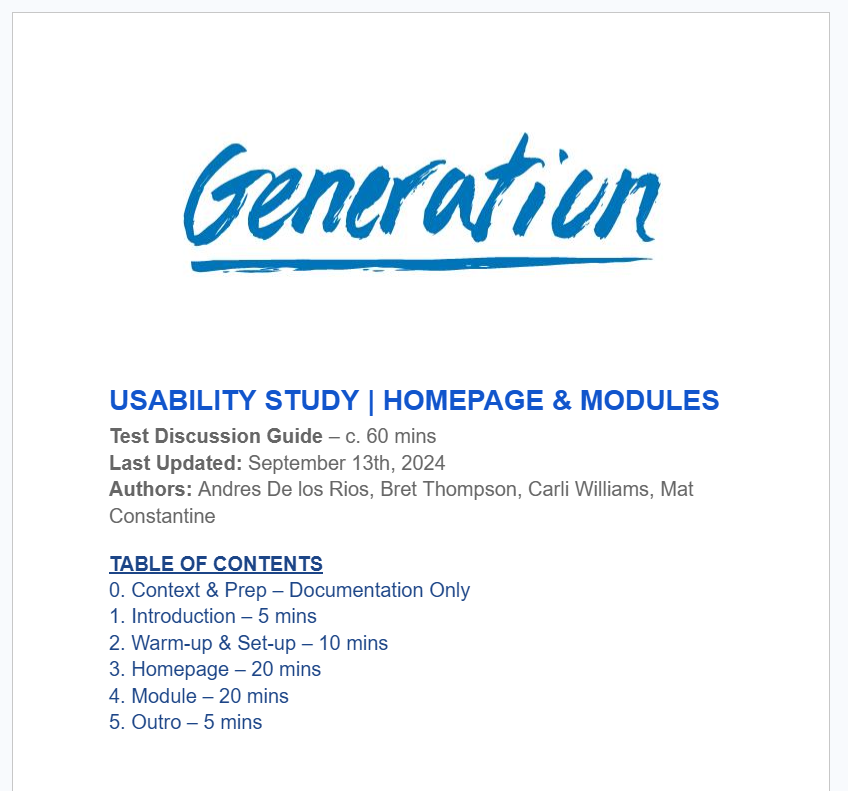
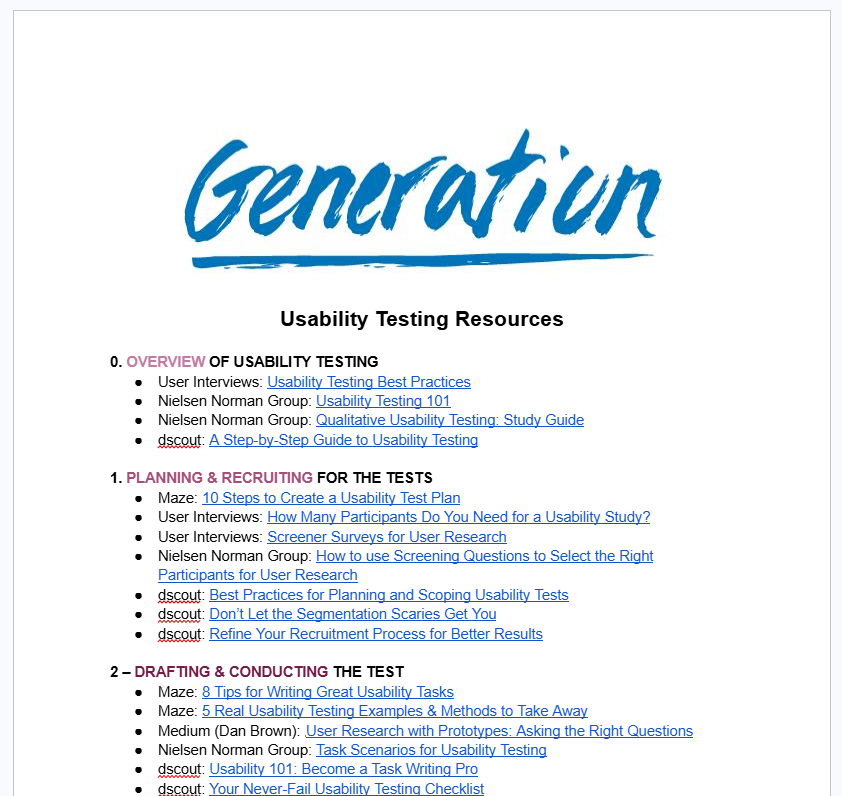
Usability Test Facilitation Guide & Usability Testing Resources
Outcome
Organizational Impact
100% project scope completion and “very satisfied” across all satisfaction measures (according to client feedback).
Scalable UX Testing Framework
Designed and delivered a reusable UX testing framework that enables Generation to continuously evaluate and improve learner experiences across programs, teams, and geographies.
Global Learner Impact
Laid the foundation for improving the online learning experience for 17,000+ learners by equipping the Online Learning Team with a playbook of proven tools and tactics.
Client feedback from Generation reinforced the value of this work:
“We cannot speak more highly of both Bret and Andres, who have expertly guided the initiative across its different stages. Their professionalism, expert knowledge and caring nature have ensured a successful engagement - thank you!”
“The solutions we have worked on with Bret and Andres speak directly to the user experience for our online learners - by having a UX testing framework we can test our hypothesis for improvement of the Canvas environment and action solutions that will benefit learner engagement , and ultimately retention, across online learning journeys.”
Reflection
Alignment upfront prevents downstream friction.
Alignment during scoping was critical in turning an initially ambiguous problem into a clearly defined plan, ensuring all stakeholders shared expectations on goals, deliverable, and success criteria. This upfront clarity minimized rework and kept the project focused despite time, resource, and scheduling constraints.
Research as a stakeholder enabler.
Beyond generating insights, this engagement reinforced the role of UX research in building stakeholder confidence and capability. By providing clear frameworks and documentation, the team was empowered to independently run future studies and advocate for user-centered decisions.
The value of systems over one-off studies.
Rather than focusing on a single usability test, this project reinforced the long-term value of building reusable usability testing and research systems. Creating a scalable framework will the organization to continuously generate insights, extending impact far beyond the initial engagement.
On a personal note, this was an incredible experience to not only advance my skillset and build new lasting relationships, but to also give back to an organization that’s providing opportunities to individuals and communities for upward economic mobility that would otherwise be inaccessible. In total, I contributed 60+ hours of volunteer time. Through Autodesk’s volunteer match program, I was able to log these hours and donate $600 to charitable organizations creating a rewarding experience with positive real-world impact.

